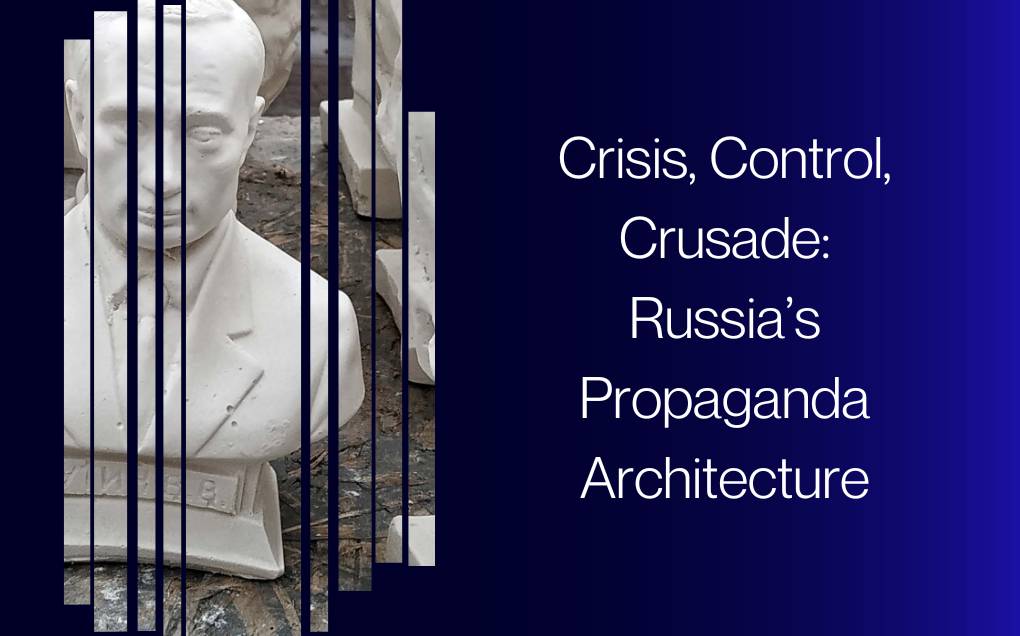
Russia’s capacity to maintain domestic support for a prolonged war rests less on the substance of individual messages than on the communication system that converts uncertainty into perceived strategic coherence. Through layered and temporally sequenced messaging, this system stabilises public interpretation during crises. This research, the fourth consecutive NATO StratCom COE examination of Russian internal communication strategies, demonstrates that the Kremlin’s propaganda apparatus has evolved from a rigid hierarchy into an adaptive ecosystem capable of absorbing shocks, testing narrative frames, and consolidating messaging across platforms. Understanding this architecture – its timing vulnerabilities, platform dependencies, and structural fault lines – is essential for designing effective strategic communication responses.
10th August 2026
Crisis, Control, Crusade: Russia’s Propaganda Architecture